Post-Graduation Work Permit Canada: 2026 Eligibility and Application Guide
Post-Graduation Work Permit Canada: 2026 Eligibility and Application Guide
A post-graduation work permit, commonly called a PGWP, allows eligible graduates of certain Canadian educational programs to gain work experience in Canada.
A PGWP is an open work permit. It normally allows its holder to work for most eligible employers and change employers without obtaining a new employer-specific permit.
However, graduating from a Canadian school does not automatically make you eligible. The institution, program, study history, language results and—in some cases—field of study must meet current requirements.
Last reviewed: September 23, 2026
What is a PGWP?
The Post-Graduation Work Permit Program allows eligible international graduates to work in Canada after completing their studies.
Depending on the program and applicant’s circumstances, a PGWP may be issued for up to three years.
A PGWP does not require:
• A job offer before applying.
• A Labour Market Impact Assessment.
• One specific employer.
• Employment in only one province.
A PGWP does not guarantee permanent residence. Canadian work experience may help someone qualify for an immigration program, but every permanent-residence program has separate eligibility and selection requirements.
Basic PGWP eligibility requirements
An applicant generally must:
• Complete a PGWP-eligible program at an eligible designated learning institution.
• Complete a program lasting at least eight months—or 900 hours for certain Quebec programs.
• Receive a degree, diploma or certificate from a credit-earning program.
• Maintain full-time student status during each academic semester.
• Apply within 180 days after receiving confirmation that the program was completed.
• Have held a valid study permit at some point during those 180 days.
• Meet the applicable language requirement.
• Meet a field-of-study requirement when applicable.
• Satisfy the rules that apply to studying inside or outside Canada.
Part-time study during the final semester may be allowed when the student needs only a reduced course load to complete the program.
Special rules and exceptions may apply to authorized leaves, accelerated studies, transfers and flight-school graduates.
Confirm school and program eligibility
A school appearing on Canada’s DLI list does not mean every program offered by that institution qualifies for a PGWP.
Before paying tuition, verify:
• The institution is a DLI.
• The institution offers PGWP-eligible programs.
• Your specific program is PGWP-eligible.
• Your program satisfies the minimum duration.
• A field-of-study requirement does not make the program ineligible.
• The program is not excluded because of a curriculum-licensing arrangement.
Public-private curriculum-licensing programs are generally not PGWP-eligible, subject to limited transitional exceptions.
Always check the current DLI information and obtain confirmation from the institution.
Language requirements
Most PGWP applicants must submit an approved English or French language test.
Graduates of bachelor’s, master’s and doctoral programs generally need:
• English at CLB 7 in reading, writing, listening and speaking; or
• French at NCLC 7 in all four abilities.
Graduates of other university programs generally need CLB or NCLC 7 in all four abilities.
Graduates of other college, polytechnic or non-university programs generally need CLB or NCLC 5 in all four abilities.
IRCC currently accepts the following tests:
English:
• CELPIP-General.
• IELTS General Training.
• PTE Core.
French:
• TEF Canada.
• TCF Canada.
The examination must generally be taken in person, and the results must be less than two years old when the PGWP application is submitted.
IELTS Academic and PTE Academic may be used by schools for admission, but they are not the versions IRCC currently lists for PGWP applications.
Field-of-study requirements
A field-of-study requirement may apply when:
• The applicant completed a college, polytechnic or other non-university program; or
• The applicant completed a university program that was not a bachelor’s, master’s or doctoral degree; and
• The relevant study permit application was submitted on or after November 1, 2024.
Graduates with bachelor’s, master’s or doctoral degrees do not currently need to satisfy a PGWP field-of-study requirement.
Applicants who submitted their study permit application before November 1, 2024 are also generally exempt from the field-of-study requirement.
Eligibility is determined using the program’s six-digit Classification of Instructional Programs code, known as a CIP code.
The eligible fields relate to occupations experiencing longer-term labour shortages. The list includes programs in areas such as:
• Agriculture and agri-food.
• Education.
• Health care and social services.
• Science, technology, engineering and mathematics.
• Skilled trades.
• Transportation.
The exact CIP code is more important than the general program title. Two programs with similar names can have different codes and different results.
IRCC has frozen the eligible field-of-study list for 2026, but applicants should still check their specific CIP code before applying.
How long can a PGWP be valid?
The duration depends on the program’s level and length and the expiry date of the applicant’s passport.
Programs from eight months to less than two years
IRCC may issue a permit for up to the same length as the study program.
For example, completing a nine-month eligible program may result in a PGWP of up to nine months.
Programs lasting two years or longer
IRCC may issue a PGWP valid for up to three years.
Master’s degree programs
An eligible master’s graduate may qualify for a three-year PGWP even if the master’s program was shorter than two years, provided the program lasted at least eight months—or 900 hours for an eligible Quebec program—and all other conditions are satisfied.
This special duration rule does not generally apply to certificates or diplomas.
Completing more than one program
IRCC may combine the lengths of multiple eligible programs when:
• Every program is PGWP-eligible.
• Each program lasts at least eight months or satisfies the applicable Quebec-hour requirement.
• The applicant meets the requirements applying to all programs.
A person cannot receive another PGWP if they previously received one after an earlier program.
Passport expiry can shorten a PGWP
A PGWP cannot normally be issued beyond the applicant’s passport expiry date.
Before applying, make sure your passport is valid for the entire period for which you may qualify.
If IRCC shortens the permit only because the passport expires early, the permit may contain a note explaining that an extension is possible. After obtaining a new passport, the applicant must normally apply on paper for the remaining eligible period.
When should you apply?
You have up to 180 days after your school confirms that you completed your program.
The completion date may be shown through:
• A completion letter.
• An official transcript.
• A degree, diploma or certificate.
• The date the school provides final marks.
Do not automatically wait until the end of the 180-day period. Your immigration status and ability to work can be affected by when you apply.
Your study permit must have been valid at some point during the 180-day application period.
Applicants can submit an eligible PGWP application from inside or outside Canada. PGWP applications can no longer be made at a Canadian port of entry.
Documents commonly required
A PGWP application may include:
• A valid passport.
• A program-completion letter.
• An official transcript.
• A degree, diploma or certificate.
• Proof of full-time study.
• Approved language test results.
• Evidence of the program’s eligible CIP code when required.
• Proof explaining an authorized leave or part-time semester.
• A medical examination when required for the intended occupation.
• Additional documents requested through the personalized checklist.
The online system may describe language evidence as optional even when the applicant is legally required to provide it. Required proof should not be omitted simply because the upload field says “optional.”
Applicants subject to a field-of-study requirement may need to upload their CIP evidence under the Client Information section.
How much does a PGWP cost?
The current government fee is CAD $255:
• CAD $155 work-permit processing fee.
• CAD $100 open-work-permit holder fee.
Additional costs may apply for biometrics, medical examinations or restoration of status.
Always verify government fees immediately before submitting an application.
Can you work while waiting for a decision?
You may be authorized to work full-time while IRCC processes your PGWP application if:
• Your study permit was valid when you submitted the application.
• You completed your study program.
• You were eligible to work off campus during your studies.
• You did not exceed the permitted work hours while studying.
• You submitted the PGWP application before your study permit expired.
• You continue satisfying all applicable conditions.
IRCC normally provides an automated letter that eligible applicants can show to employers.
If you submit the application after your study permit expires and need to restore your status, you cannot work until the PGWP is approved.
Do not begin or continue employment based only on the fact that an application was submitted. Confirm that you meet every requirement for interim work authorization.
What if your study permit expires first?
If your study permit will expire before you receive proof of program completion, you may need to:
• Apply for a visitor record before the study permit expires; or
• Leave Canada and apply for the PGWP from outside Canada.
If you remain in Canada and allow your status to expire, you may have up to 90 days to apply for restoration together with the PGWP application.
Restoration involves additional fees, and you cannot work while waiting for approval.
Reasons a PGWP may be shorter or refused
A PGWP may be shortened or refused because:
• The passport expires early.
• The program or institution is not eligible.
• The program was too short.
• The applicant did not maintain full-time status.
• An academic leave was not authorized or properly documented.
• Too much of the program was completed through ineligible distance learning.
• Required language results were missing, expired or insufficient.
• The program did not satisfy an applicable field-of-study requirement.
• The application was submitted after the deadline.
• The applicant previously received a PGWP.
• The study permit conditions were violated.
• The application contained incomplete or inconsistent information.
Can a PGWP be renewed?
A PGWP is normally issued only once and is not routinely renewable.
An extension may be possible when the original permit was shortened because the applicant’s passport expired before the end of the full eligible period.
Before a PGWP expires, review other possible work-permit or permanent-residence options. Do not assume that submitting a permanent-residence profile will automatically allow you to keep working.
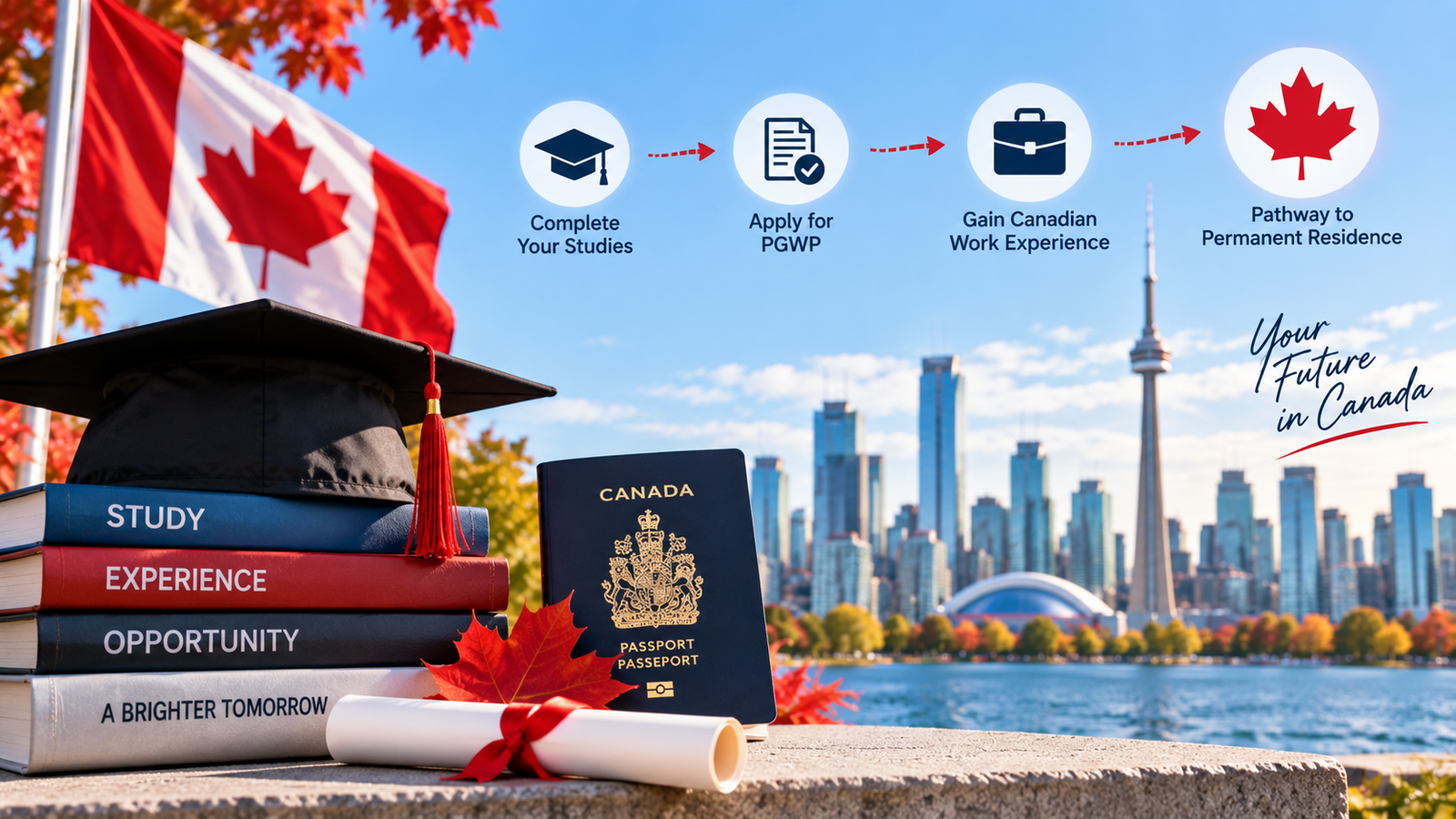
PGWP and permanent residence
Canadian work experience gained with a PGWP may help someone qualify for programs such as:
• The Canadian Experience Class.
• A Provincial Nominee Program.
• A regional or community immigration program.
• Another federal or provincial economic pathway.
However, not every job counts for every immigration program. Employment may need to meet requirements concerning occupation, skill level, hours, authorization and period of work.
A PGWP itself does not guarantee an invitation or nomination.
PGWP planning checklist
Before choosing a study program:
• Confirm the school and program are PGWP-eligible.
• Verify the program’s CIP code.
• Check whether a field-of-study requirement applies.
• Understand the language level you will need.
• Review the rules for online study and authorized leave.
• Check how program length affects PGWP duration.
• Make sure your passport will remain valid.
• Remember that a PGWP can normally be issued only once.
Before applying:
• Calculate the 180-day deadline.
• Confirm your immigration status.
• Obtain the completion letter and transcript.
• Take the correct language test.
• Gather proof of field-of-study eligibility when required.
• Include explanations for any academic leave or part-time period.
• Pay both required fees.
• Keep copies of the complete application.
Official information
PGWP overview and duration:
https://www.canada.ca/en/immigration-refugees-citizenship/services/study-canada/work/after-graduation/about.html →
PGWP eligibility:
https://www.canada.ca/en/immigration-refugees-citizenship/services/study-canada/work/after-graduation/eligibility.html →
Field-of-study requirements:
https://www.canada.ca/en/immigration-refugees-citizenship/services/study-canada/work/after-graduation/eligibility/field-of-study.html →
How to apply:
https://www.canada.ca/en/immigration-refugees-citizenship/services/study-canada/work/after-graduation/apply.html →
Would you like professional guidance?
PGWP eligibility can depend on dates, school records, language results, program type and immigration status. If you need help understanding how the current rules apply to your circumstances, you may choose to speak with an authorized Canadian immigration professional.
Talk to an Immigration Professional →
Professional assistance does not guarantee approval or permanent residence. Immigration decisions are made exclusively by Canadian immigration authorities.
This article provides general educational information and is not legal advice. Immigration rules can change. Verify current requirements with IRCC before making decisions or submitting an application.